A research-grounded mobile-first prototype in one week — demonstrating the ability to prioritize rurgency under constraint
Timeline · 1 weeks

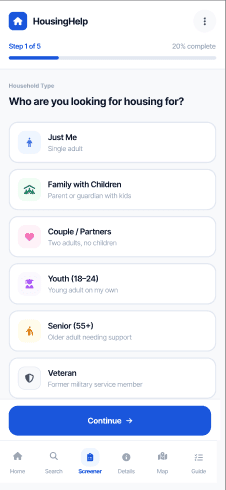
Design an experience that removes every possible barrier between a user’s urgent need and a real-world action, while being honest about the limits of what any tool can promise.
xisting tools bury users in eligibility forms, unclear next steps, and dead-end results.
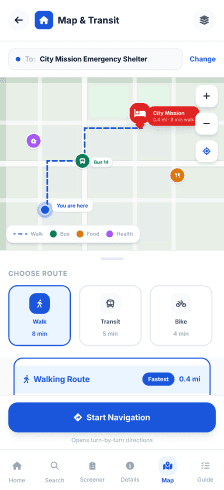
The design concentrated on a small number of critical decision moments: identifying the housing issue, confirming location, reviewing relevant resources, and taking immediate action.
Users in acute housing crisis are operating under what psychologists call ‘bandwidth scarcity’.The design responded by reducing the interaction to its absolute minimum: fewer choices, clearer labels, no optional features at critical moments.
users frequently abandon housing resource tools not because they’re ineligible, but because they believe they might be, and the process of finding out feels too costly. This is a form of anticipatory anxiety driven by ambiguity aversion.
Recovery paths were designed with the same care as primary flows: what can the user do next? Who else can they call? This reframe from ‘failure’ to ‘continuation’ is rooted in appraisal theory and the principle that perceived agency matters even when options are limited


barrier identify as the primary abandonment driver
states elevated to first-class design problems
paths designed with equal rigor to primary user flo